We use cookies to improve your experience on our website.
By browsing this website, you agree to our use of cookies.
15th June 2025
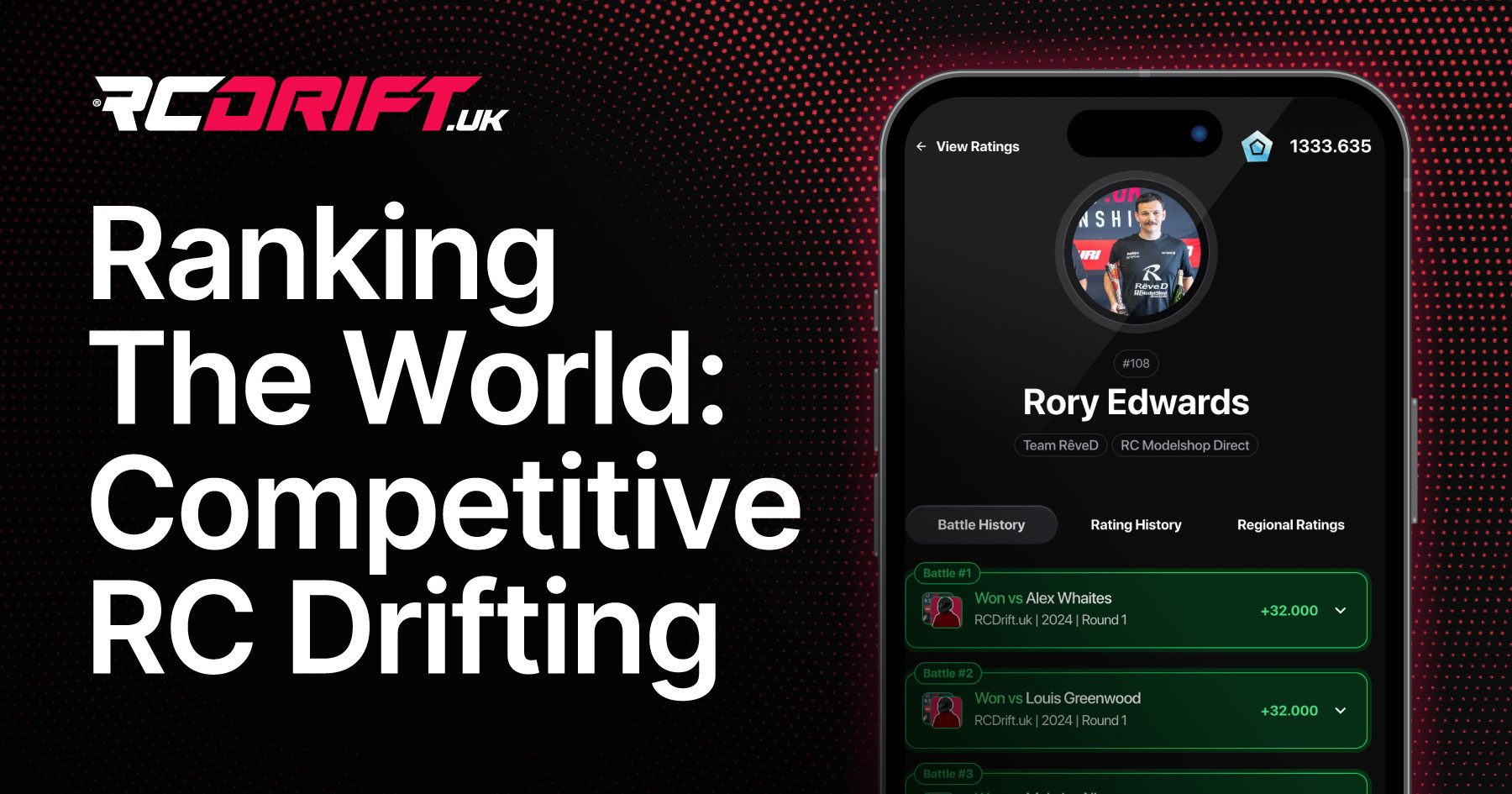
In 2025, the world of RC drifting is more competitive and connected than ever. But despite its growth, there’s still no universal ranking system for professional RC drifting.
This lack of system makes it hard to compare drivers across countries or regions, and nearly impossible to track who’s truly at the top of the game.
More than that, it limits the sport’s potential to evolve, attract sponsors, and develop an international competitive format that fans and drivers alike can rally behind.
The answer is simple in theory, but complex in practice. There are two major challenges that have prevented a global ranking system from being established:
RC drifting is judged on nuanced criteria: line, angle, proximity, style, flow — and it’s subjective by nature. This makes it difficult to assign consistent, numeric values to a driver’s performance, especially across different judges, countries, or formats.
The only reliable way to handle this is by looking at a driver’s average performance across multiple tournaments. Over time, patterns emerge, and individual judging inconsistencies are smoothed out — but this only works if all the data is tracked and connected.
Without a system to do that, you can't build a global ranking. At best, you're comparing apples to oranges.
Which brings us to the second challenge...
Even if you had a way to quantify driver performance, there’s currently no unified way to collect and connect the results.
Most events are run independently, using different formats and local rules, with no central hub for results. Even when high-level drivers compete internationally, their performances aren’t linked into a broader picture.
This fragmentation makes it nearly impossible to track performance over time — let alone compare it on a global scale.
Over the past three years, we’ve been developing the tools, systems, and strategy needed to solve this problem. Here’s how we’re laying the foundation for a universal RC drifting ranking system.
The first piece of the puzzle was building a ranking model that can compare drivers accurately and fairly, regardless of where they’re from.
To do this, we looked at proven systems used in traditional competitive environments like chess (Elo) and tennis (ATP/WTA). These systems have been stress-tested over decades and handle things like:
All relevant challenges in RC drifting.
But we didn’t stop there. RC drifting has its own dynamics:
So we enhanced this base algorithm with drift-specific rules, tuned through hundreds of simulated events and real-world data. The result is a rating system designed to reflect a driver’s true skill — consistently, fairly, and over time.
To make this work at scale, we need tournaments to happen frequently and globally, in a way that’s consistent and connected.
That’s why we’ve built our own free-to-use tournament software — available right now through our website. It’s designed to make hosting RC drift competitions as smooth as possible for track owners and organisers.
Features include:
With every tournament that’s tracked with our software, the global system gets stronger. The data becomes more reliable, and the rankings mature and become more meaningful and accurate.
As more events are run using the system, within each region — say the UK, Europe, or North America — we start to see driver overlap. Competitors attend multiple events, battle each other, and build a local performance hierarchy within their region.
At this stage, the ranking system works well. But here’s the challenge:
The #1 driver in North America can’t be reliably compared to the #1 driver in Europe — until they compete in overlapping tournaments, head to head.
This is the missing link that prevents regional rating systems from becoming a true global ranking.
To solve this, inter-regional tournaments are essential.
At RCDrift.uk, we’re actively planning a calendar of international-level events over the coming years. These events will bring top drivers from different regions together, creating natural overlap between rating pools and strengthening the global system.
We’ll also be working with other major tournament organisers worldwide to integrate their results into the universal ranking system and ensure their events contribute to the bigger picture.
Over time, as these overlaps increase, the ranking will self-correct and mature — delivering more accurate comparisons across borders, and a true sense of who sits at the top of the global RC drifting world.
We believe the time is right for a global ranking system — but we know we can’t build it alone.
Whether you’re a driver, judge, organiser, or track owner, you have a role to play in shaping the future of RC drifting.
We want to give a special thanks to those already working behind the scenes to make this a reality.
Together, we can build the most exciting, competitive, and globally-connected era RC drifting has ever seen.
